
Rising Fertilizer Prices: How Improving Nutrient Efficiency Can Protect Your Bottom Line

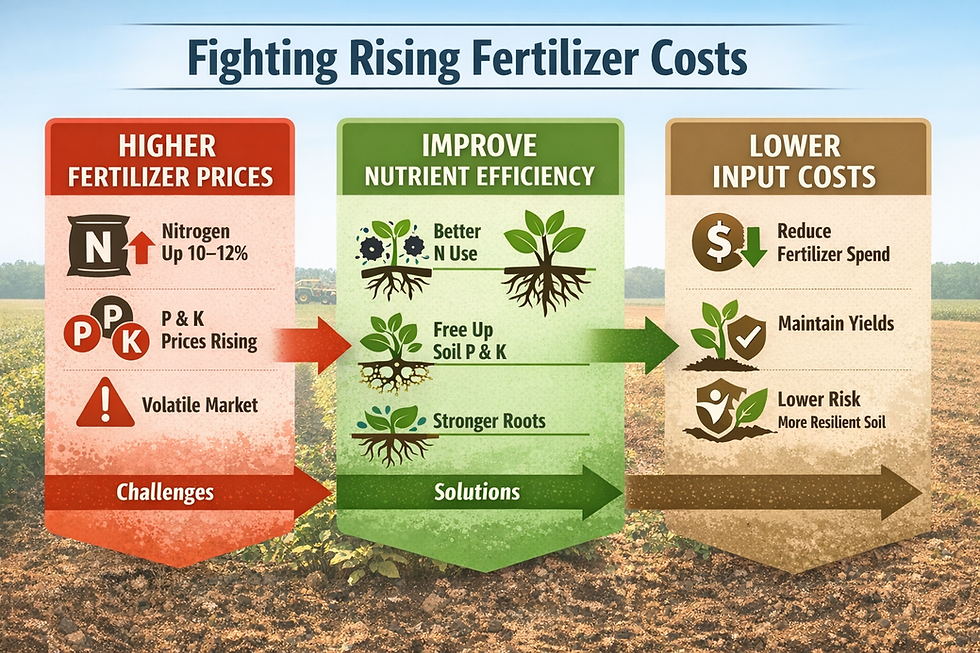
Over the last several weeks, fertilizer prices have moved sharply higher — and not gradually. Nitrogen has seen some of the fastest month‑over‑month increases farmers have faced since 2022. Retail prices for urea, UAN, and anhydrous ammonia have jumped 5–13% in just one month, driven by global supply disruptions, rising energy costs, and geopolitical instability that has restricted fertilizer shipments ahead of spring planting.
Phosphate prices, including DAP and MAP, are up 10-11% year over year.
For many corn and soybean producers, this creates a familiar but uncomfortable question:
How can I maintain yield when the cost of nutrients keeps climbing?

At Soil Carbon Innovations, we believe part of the answer lies not in applying more fertilizer, but in getting more out of what you already apply — and what already exists in your soil.
Fertilizer prices are rising — and volatility is back
Recent market data shows that all major fertilizers are more expensive than they were just a month ago.
The key concern for farmers isn’t just higher prices — it’s volatility and uncertainty. Retailers are shortening price‑lock windows, availability is becoming less predictable, and many producers are being forced to make nutrient decisions under pressure.
This environment rewards systems that improve nutrient efficiency and reduce dependence on high-priced inputs.
Nitrogen efficiency matters more when nitrogen is expensive
Nitrogen is typically the largest single fertilizer expense in corn production. When prices spike, every lost pound — through leaching, volatilization, or denitrification — becomes more costly.
Living Carbon is designed to support nitrogen use efficiency by improving soil biological function. Rather than acting as a replacement for nitrogen fertilizer, Living Carbon works alongside applied nitrogen to:
Increase microbial activity that helps cycle nitrogen into plant‑available forms
Improve soil structure and aggregation, supporting better water infiltration and reduced N loss
Support a more active rhizosphere, where roots and microbes exchange nutrients more efficiently
When nitrogen is stabilized in the soil system and taken up more efficiently by the crop, farmers are better positioned to maintain yields with fewer losses, even when fertilizer prices rise.
This does not mean “no nitrogen.” It means making each unit of nitrogen work harder.
Unlocking existing soil nutrients instead of buying more
Most agricultural soils already contain large reserves of phosphorus and potassium, often far more than a single crop requires. The challenge is that much of this nutrient pool exists in forms that are chemically or biologically unavailable to plants in a given season.
Living Carbon introduces a diverse population of beneficial microbes along with organic carbon and mineral components that help:
Stimulate microbial processes that solubilize tied‑up phosphorus
Improve cation exchange and nutrient retention related to potassium availability
Increase root exploration and nutrient access through improved soil structure
As a result, many growers can reduce maintenance applications of P and K, particularly on soils that already test medium to high, while monitoring soil tests and crop response over time.
In a year when fertilizer prices are climbing, even partial reductions in purchased phosphorus and potassium can significantly offset rising input costs — without sacrificing crop performance.
A different way to think about fertilizer risk
Living Carbon is not about chasing the lowest fertilizer rate. It’s about reducing risk:
Risk of paying top‑of‑the‑market prices for nutrients
Risk of nutrient loss due to weather or soil conditions
Risk of over‑applying inputs that don’t fully benefit the crop
By improving biological nutrient cycling and soil function, Living Carbon helps farmers shift part of their fertility strategy from input‑driven to efficiency‑driven.
When fertilizer prices are stable, that’s helpful. When fertilizer prices spike, it becomes essential.
Moving forward in a high‑cost input environment
No one knows exactly where fertilizer prices will settle in the coming months. What is clear is that volatility has returned to the nutrient market — and that volatility puts pressure on margins.
Building soils that retain nutrients, cycle minerals, and support efficient uptake gives farmers more flexibility when markets move against them.
Living Carbon was developed to support that goal: helping farmers protect yields, reduce unnecessary nutrient spending, and build a more resilient soil system — especially as fertilizer costs rise.
It’s Not Too Late
Even with fertilizer prices rising and spring decisions already underway, it’s not too late to improve nutrient efficiency this season. Soil Carbon Innovations can still help by providing Living Carbon, a biologically active soil amendment that works alongside your existing fertility program. Living Carbon supports soil biology, improves nutrient cycling, and helps crops get more value from both applied fertilizers and nutrients already present in the soil.
In a year marked by volatile nitrogen, phosphorus, and potassium prices, small gains in efficiency can translate into meaningful cost savings without sacrificing yield. If you’re looking for practical ways to reduce fertilizer risk and build more resilient soils, there is still time to put Living Carbon to work on your farm. Please Contact Us Today!


Comments