
Soil Is Not Dirt: Why That Difference Matters More Than Ever

Most people use the words soil and dirt interchangeably. But in agriculture, that distinction matters—a lot.
Dirt is what you sweep off the shop floor.
Soil is what grows food.
Understanding the difference is the first step toward healthier crops, lower input costs, and more resilient farms.
Dirt Is Dead. Soil Is Alive.
At a glance, soil may look like uniform brown material. But as Gary Zimmer explains in The Biological Farmer, soil is actually a living system, not just ground-up rock.
Healthy soil is made up of four main components:
Minerals (from weathered rock)
Water
Air
Organic matter, including living organisms

In a well-functioning soil, roughly half of the volume is pore space—filled with air and water that roots and microbes need to survive. Dirt, by contrast, is compacted, lifeless, and lacks structure. It may hold plants upright, but it doesn’t truly feed them.
When soil loses its structure and biology through erosion, compaction, excess tillage, or harsh fertilizers, it stops behaving like soil and starts behaving like dirt.
Soil is a Biological System, not a Chemical Container
One of the biggest mistakes modern agriculture has made is treating soil like a chemical substrate—something that simply holds plants while we spoon-feed nutrients.
Zimmer emphasizes that soil is better understood as a soil–plant–microbe system, where:
Plant roots release sugars and organic compounds into the soil
Microbes feed on those compounds
Microbes, in turn, make nutrients available to plants
Organic matter and carbon act as the glue that holds everything together
When this system is working, nutrients cycle efficiently, roots grow deeper, and crops become more resilient to stress.
When the system breaks down, farmers are forced to replace biology with inputs—often at increasing cost and decreasing return.
Organic Matter is Small in Percentage, Huge in Impact
Typical agricultural soils contain only 1–6% organic matter, yet that small fraction controls a massive share of soil function.
Organic matter—and especially stable carbon (humus)—is responsible for:
Holding nutrients in plant-available forms
Improving water infiltration and water-holding capacity
Creating soil aggregates that resist erosion
Feeding beneficial soil organisms
Buffering against nutrient imbalances and salt stress
Zimmer notes that increasing organic matter by just 1% can significantly raise yield potential and dramatically improve soil performance. That’s not because organic matter is fertilizer—it’s because it makes everything else work better.
Soil Carbon is the Engine, not the Add-On
Carbon isn’t just a climate buzzword—it’s the energy source of the soil system.
Carbon feeds microbes.
Microbes cycle nutrients.
Nutrients feed crops.
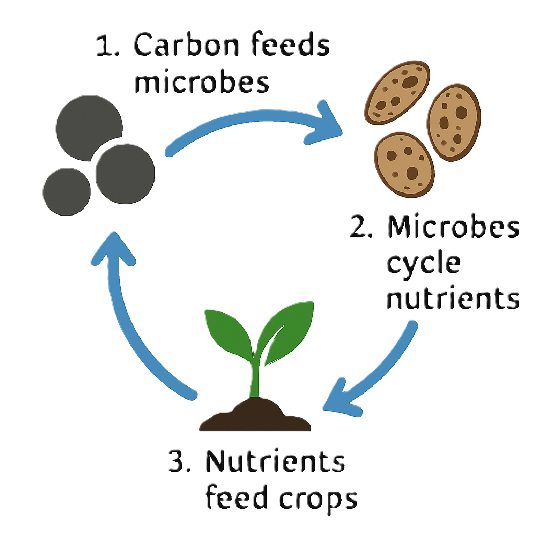
When soils lose carbon through erosion, excessive nitrogen use, or over-tillage, the system weakens. When carbon is restored—through crop residues, compost, cover crops, and biologically stable amendments—the system rebuilds.
This is why biological farming focuses less on “feeding the plant” and more on feeding the soil.
Why This Difference Matters on Your Farm
If soil is treated like dirt:
More fertilizer is required to maintain yields
Nutrients leach or volatilize instead of cycling
Roots stay shallow and stressed
Crops are more vulnerable to drought, disease, and pests
Profitability becomes increasingly dependent on input prices
If soil is treated as a living system:
Nutrients are released gradually and efficiently
Water is stored and used more effectively
Roots explore more soil volume
Crops become more resilient and balanced
Inputs work with biology instead of against it
The difference isn’t philosophical—it’s practical.
Stop Managing Dirt. Start Building Soil.
Healthy soil doesn’t happen overnight, and it doesn’t come from a single product. It comes from consistent biological management that builds structure, carbon, and life over time.
As Gary Zimmer puts it plainly, "we can’t keep treating soil like dirt."
The farms that thrive in the future will be the ones that understand—and manage—the difference.
Where Living Carbon Fits
Building real soil—not just feeding crops—requires stable organic carbon. Products like Living Carbon are designed to do exactly that: add biologically active, composted carbon that feeds soil microbes, improves aggregation, and helps nutrients cycle more efficiently. Instead of treating soil like a passive growing medium, Living Carbon supports the living system beneath the crop—helping turn dirt back into soil over time.
Where Biochar Fits
Biochar plays a different but complementary role in soil health. As a highly stable form of carbon, biochar improves soil structure, increases nutrient-holding capacity, and provides long-term habitat for beneficial microbes. While biochar doesn’t feed biology directly like compost does, it creates the physical framework that allows soil life and nutrients to function more efficiently—especially in degraded or low‑CEC soils.


Comments